
International Lighthouse Lightship Weekend GB2TCL
This year’s event – 18-19 August 2012 – Duration 48 hours from 0001 UTC 18.8.2012
Next year’s event – 17-18 August 2013
Welcome to the web site for the ILLW. This annual amateur radio event was started in Scotland by John Forsyth, GM4OOU, and the late Mike Dalrymple (GM4SUC), both members of Ayr Amateur Radio Group (AARG). Through the years the event has grown probably far beyond what John and Mike envisaged for it all those years ago. The fact that some 85 countries have been represented in this event since inception clearly shows that it is well on its way to becoming a premier event on the ham radio calendar.
The event evolved from the Scottish Northern Lighthouses Award Weekend a biennial event which was first held in 1993 and became the ILLW in 1998. For the history of the event see this page and here for the original ILLW web site and 1998 list by Bob Dixon, GM3ZDH. Over the years it has continued to grow and to date more than 450 lighthouses and Lightships in some 50 countries around the world are participating in the event each year.
The event is always held on the 3rd full weekend in August starting at 0001 UTC on Saturday and finishing at 2359 UTC on Sunday. It also coincides on the Sunday with International Lighthouse Day an event organised by the Association of Lighthouse Keepers whereby many world lighthouses are open to the public for the day.
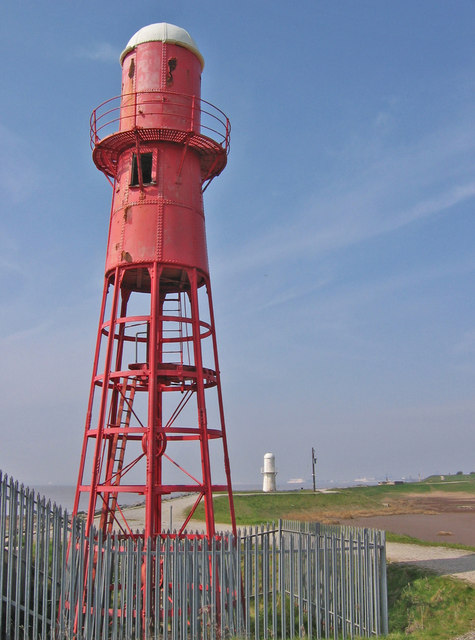
The leading lights (also known as range lights) sited at Thorngumbald and Saltend on the banks of the River Humber in EastYorkshire
Thorngumbald Clough Lights
The leading lights (also known as range lights) sited at Thorngumbald and Salt end on the banks of the River Humber in East Yorkshire were considered by the Brethren of Trinity House, Kingston upon Hull in 1868 and temporary marks were set up and tested. The results were successful and in February 1869 the Brethren submitted their plans to Trinity House in London for the establishment of permanent lighthouses at these two locations. Thompson and Sather of Hull erected all four lighthouses for £1064.
The two lighthouses at Thorngumbald Clough were established in July 1870 and built on the foreshore on half an acre of land purchased at a cost of £110 from Mr. Hugh Baxter in 1869. When the military officer in charge of the Paull battery first heard of the proposals he complained that they would block his line of fire in defense of the river but was later satisfied that they could be dismantled if necessary in time of war.
The High Light was constructed of wrought iron girders erected on foundations of masonry. It was a red painted wrought iron cylindrical tower 49 feet high. The circular tower was open lattice at the base for about two thirds of the height with the remainder plated in to form the lantern and storerooms. Access to the lantern was by a spiral staircase inside the open lattice work to the storeroom and then by an iron ladder from the storeroom to the lantern.
The lantern’s focal plane was 50 feet above high water. The light was originally powered by capillary wick oil lamps, but converted to electricity in 1926. The light was a holophote prismatic lens assisted by a prismatic reflector, with the resulting white fixed bright light being visible 12½ miles.
The moveable Low Light was a white painted wrought iron cylindrical tower 32 feet high originally built on a railway trolley and placed 370 feet in front of the high light. This enabled the light and the trolley sitting on railway lines to be moved along for a maximum distance of 26 feet in front of the high light to take into consideration the constantly changing shape of the sandbanks. In 1888 the track was extended by 15 feet and the light moved 7 feet 3 inches to make the correct lead with the high light. A temporary light was fixed to a pole and removed on October 15th when the move was complete.
The focal plane was 28 feet above high water and exhibited a fixed white light. The single catoptric fixed white light powered by two burners gave a nominal range of 10½ miles.
A keeper’s cottage was built by Messrs. Story and Jagger of Hull at a cost of £452 5s 2d (which also included the foundations for the high lighthouse) and was close to the low light. The low light was painted white and the cottage painted red. The keeper was paid a salary of £55 per annum and in 1939 when the keeper was Mr. H.Curtis his salary was £110 per annum with free coal and light.
Both lights were originally controlled by a clockwork switch which needed to be wound on a monthly visit by the attendant, and switched the light on 15 minutes before sunset and off 15 minutes after sunrise. Before electrification the lights together consumed 214 gallons of oil a year held in storage tanks capable of holding 165 gallons.
Today the keeper’s cottage has long since been demolished, and the moveable low light is no longer on railways lines but fixed to its base thus rendering it immovable. The high light no longer has a spiral staircase inside its frame but a series of iron ladders to take you to the storeroom.
The flood wall had recently and deliberately breached in order to flood and create a nature wetland making access to the lights no longer possible. This action is part of a national policy.
However both lights are fully operational and now can only be reached by walking along the shoreline from Paull.



You must be logged in to post a comment.