Ground-Wave Propagation

Radio Propagation

Ground Wave Propagation

Ground wave is the part of a radio signal that travels close to the surface of the earth. It is most useful on the lower radio frequencies and works best with vertical polarisation.

Vertical polarisation Earth return path Lower frequency advantage

What ground wave means

Ground wave works best with vertical polarisation. One side of the antenna is the metal vertical radiator, and the other side is the earth ground, radial system, vehicle body, counterpoise, or other ground return system.

In simple terms, the radio wave travels along the surface of the earth. Part of the field is in the air and part is linked to the ground. The part travelling through the air moves more easily than the part coupled into the ground, but the two parts stay tied together as one wavefront.

Because the earth is curved, the ground wave can bend round the surface for some distance. This is why low-frequency and medium-frequency stations can often be heard well beyond the visual horizon, especially over good conducting ground or seawater.
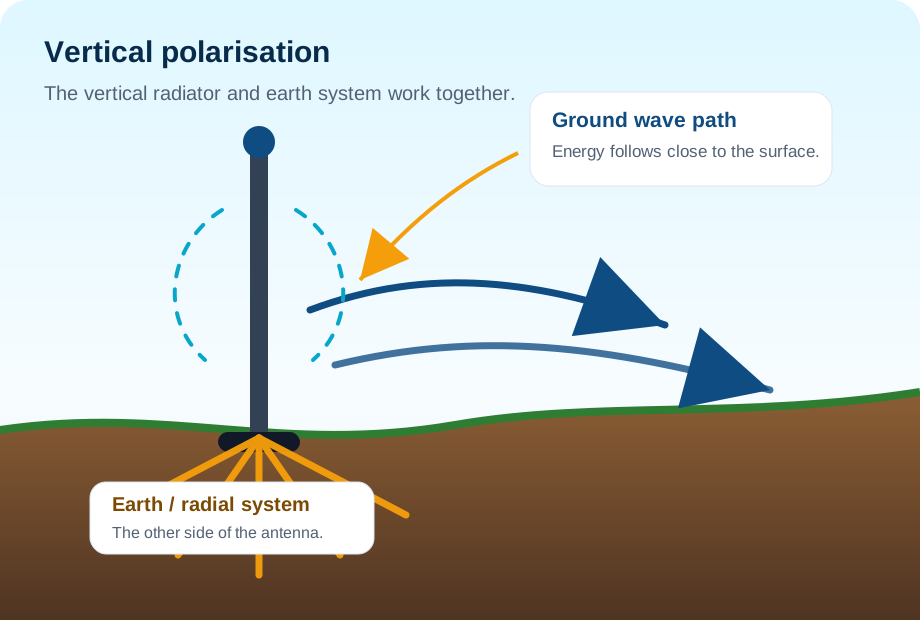
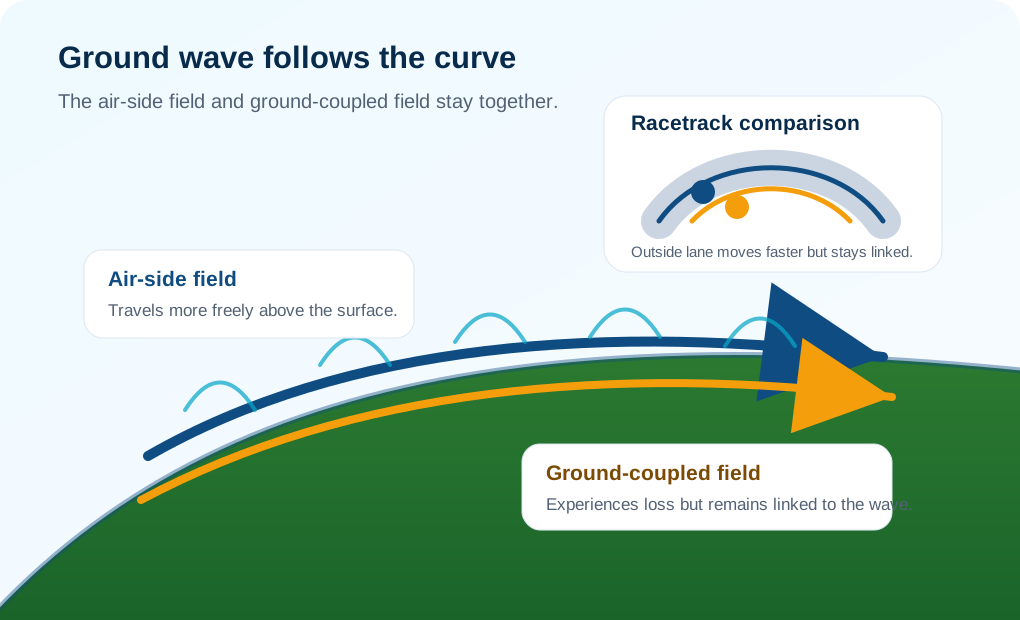
Diagram showing a vertical antenna using the earth as the return side of the antenna system.
Ground wave needs a vertically polarised field and a return path through earth, radials, or counterpoise.
How it follows the earth

The racetrack way to picture it

Diagram comparing a curved racetrack with a ground wave following the curved surface of the earth.
The wave in the air and the part coupled to the ground stay linked, so the path curves with the earth.

Why the wave bends

Think of the earth like the curved part of a racetrack. A car in the outside lane must travel faster than a car in the inside lane to stay level, but both cars still follow the same bend.

With ground wave, the field in the air travels more freely than the part coupled to the ground. The two parts cannot fully separate, so the overall wavefront bends and follows the surface.

Important: this is a simplified teaching model. The real behaviour depends on frequency, ground conductivity, terrain, polarisation, antenna efficiency, and transmitted power.
AM broadcast example

Why lower frequencies travel better by ground wave

AM broadcast stations mainly use ground wave during the day. At night, the ionosphere changes and medium-wave stations can also travel by skywave, often causing distant stations to appear and local channels to become busier.

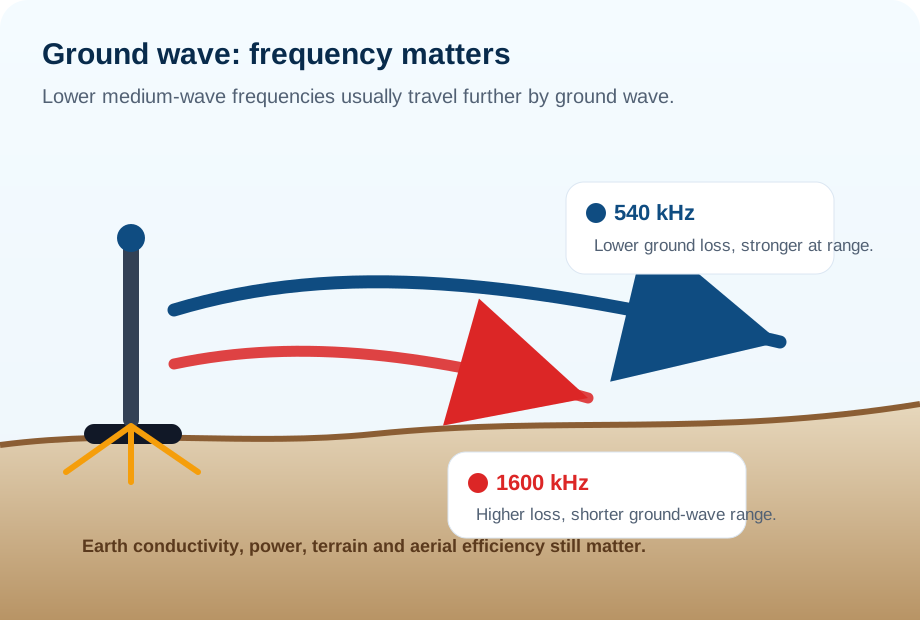
Lower frequencies usually suffer less ground loss. For example, if two AM broadcast stations run the same power from similar aerial systems, a station on 540 kHz will normally be much stronger at distance than one on 1600 kHz by ground wave.

This is why large medium-wave broadcast stations use efficient vertical masts, extensive earth systems, and carefully engineered ground systems. The antenna and the earth system work together.

Diagram showing a stronger 540 kHz ground wave compared with a weaker 1600 kHz ground wave over distance.
Lower-frequency ground wave normally holds up better over distance than higher medium-wave signals.
Amateur radio use

What this means for radio operators

Verticals suit ground wave

A vertical radiator produces vertical polarisation, which is the correct field orientation for useful ground-wave working.

The earth system matters

Poor ground, short radials, or high losses waste RF as heat. A better radial or counterpoise system improves antenna efficiency.

Sea paths are excellent

Salt water is a very good conductor, so coastal stations can get strong ground-wave coverage along sea paths.

Ground wave summary

  • Ground wave is strongest with vertical polarisation.
  • The vertical radiator and earth system act as the two sides of the antenna.
  • The wave remains coupled to the earth and can follow the earth’s curvature.
  • Lower frequencies normally travel further by ground wave than higher frequencies.
  • Good ground conductivity, radials, and seawater paths improve performance.