Category Archives: Club News

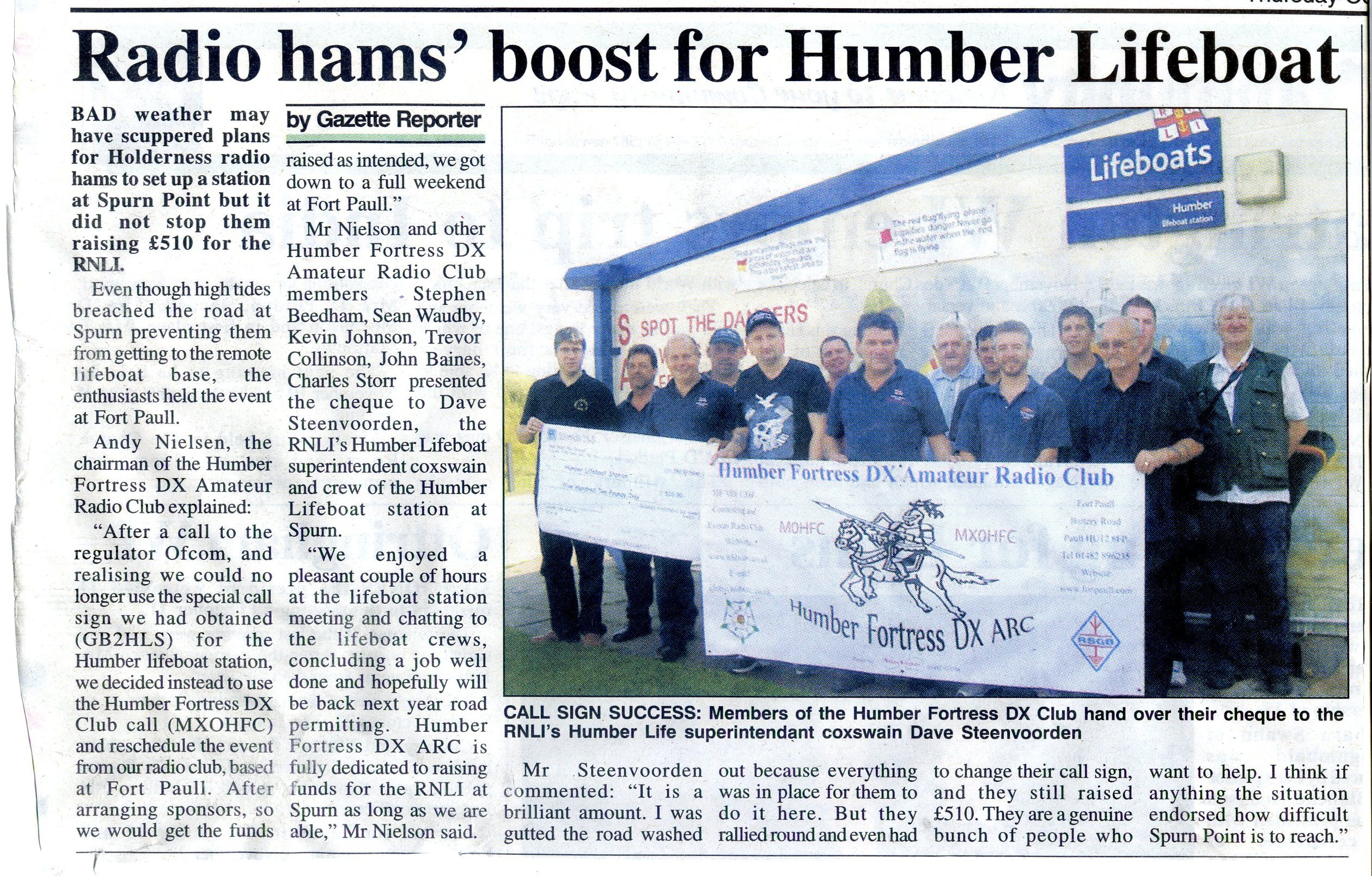
Humber Fortress DX A.R.C. activating GB2HLS over the weekend of 2nd September 2011

ACTIVATING ON THE WEEKEND OF 2ND TILL 4TH SEPTEMBER 2011

The only full time manned lifeboat station in the U.K!!!!. 

CLUB DETAILS —– http://www.hfdxarc.co.uk

Humber Fortress DX ARC (MX0HFC) will be activating GB2HLS from the Humber Lifeboat Station at SPURN POINT ,EAST YORKSHIRE.
We are doing this to raise money for the R.N.L.I which is a private funded organization and relies on public donations to keep this very important emergency service going.
The club members have been sponsored by friends/family and works mates for every 500 contacts we achieve we hope to do around 1500 in the weekend ,so this will be very much a ‘rubber stamping ‘ activation.

We will be activating 2 HF stations on Ba nds  80m, 40m ,20m, 15m and 10mtrs depending which bands are open.
Many thanks in advance to all stations we work over this great weekend event.

PLEASE ENCLOSE A STAMPED ADDRESSED ENVELOPE FOR QSL CARD IF NOT USING THE BUREAU QSL G1EYY.

ANY DONATIONS BY CHEQUE/POSTAL ORDERSMAKE PAYABLE TO…. R.N.L.I

ALL DONATIONS GLADLY RECEIVED!!!


THE HUMBER LIFEBOAT: R.N.L.B. PRIDE OF THE HUMBER


Spurn point:

This is the home of the countries only full time lifeboat crew. Out of 214 life boat stations throughout the whole of Britain and Southern Ireland; Humber is the only boat with a full crew of paid employees

The People:

The men and their families all live in the homes supplied by the RNLI.

The crew consists of a Superintendent Coxswain, a second Coxswain, mechanic, an assistant mechanic and a crew of three backed up by 10 relief crew that can be called upon to relive at the station All the crew are trained in first aid.

A local doctor can be called upon if a doctor is needed aboard a ship. In all other stations there is an honorary secretary who is responsible for granting permission to launch the lifeboat. He administers the paper work and the running of the station.

At Spurn there is no honorary secretary so the Coxswain carries out these duties, This makes Spurn a unique station within the RNLI. The station has always operated in this manner, purely due to the geography of its position. There is no better position to site the lifeboat, as it is along side the deep water channels at the entrance to the Humber Estuary This gives very easy access to seaward of the station.

The boat’s position is protected by Spurn point from northerly through east to southerly winds. Winds from the Southwest to Northwest leave the boat in an exposed position, making boarding a very dangerous task. The crew will then go and work from the dock basin at Grimsby until the wind eases, allowing the boat to return to her moorings.

The present crew and their families make up a total population of 29 people living at the station.

Each crewmember does five days on duty and then gets one day off and one weekend off in seven. While on duty the crew are not allowed to leave the station area. Apart from station duties and call outs they are free to do what they please, as long as they are available for call out 24hrs aday. This makes life very hard for the spouses and families. The spouses have to do every thing from shopping to getting the car fixed.

The children cannot go to the pictures or go to a football match with dad unless his leave day falls right. The children go to school in Easington for the infants and juniors and the seniors go to Withernsea High School.

The seniors have a mini bus that picks them up at the station at 7.45am, taking them to Easington to catch the coach to Withernsea. The smaller children are picked up at the station at 8.45am.

The lifestyle at Spurn can be very hard at times as every shopping trip has to be planned so nothing is forgotten. The nearest shop in Easington is a round trip of 16 miles.

The Lifeboat:

The present lifeboat stationed at Spurn is the Severn class boat called ” Pride of the Humber” that was totally funded by the people of Humberside and the Northeast.

The total amount raised, £1,400,000 was the largest single amount raised in one appeal at the time. The new boat is 17 m (55ft 9ins.) long, has a beam of 5.5 m (18ft.) a displacement of 37.5 tonnes a top speed of 25 knots, and a total range of 250 nautical miles at top speed. She is powered by twin Caterpillar engines each one producing 1200 bhp.

The hull is a hard chine construction of fibre reinforced composite (FRC). Tunnels and a deep bilge keel protect the propellers, so it can take the ground if needed. After capsize the boat will self-right, usually in less than 7 seconds. The wheelhouse contains permanent seating for six crew members and a doctor and a position for a stretcher.

The Lifeboat isfitted with bow thrusters to increase its agility. The electronics fitted to the boat are Radar, GPS (satellite navigation), Laser chart plotter, Echo sounder, MF radio, VHF radio, MF/VHF direction finder, speed log, anemometer and a full intercom system. She also carries an inflatable Y class boat for use in shallow water.

History of the Humber Lifeboat Station.


The first lifeboat was stationed at Spurn Point on October 29th 1810. The cost of this boat was met by subscription set-up by the Brethren of Hull trinity house who were to manage the boat and appoint the master (Cox) and mate.

The crew would be made up from the men of Kilnsea. The lifeboat then was a ten oared boat and carriage costing £284.4s.0p, Trinity house of Hull, Lloyds of London and the corporation of the city of Hull paid £50 each, the rest coming from subscription.

A very big difference to today’s cost, where a Severn class lifeboat costs more than £1,400,000. Trinity house ran and managed the lifeboat until 1st January 1908.

The Humber conservancy board looked after operation of the lifeboat until the RNLI took over the operation in 1911. Up to the RNLI Taking over the boat it is thought to have launched on more than 540 service’s, saved an entire crew from a vessel around 30 times and saved more than 760 lives.

It must be said however that records where far from complete. In 1919 the first powered vessel was placed at Spurn, the 40ft Watson class lifeboat named “Samuel Oakes.” The next three boats all Watson classed boats where all bought by the people of Bradford.

In 1977 a new era began at Spurn as a brand new class of boat was stationed there. The new 18 knot Arun class boat “CITY OF BRADFORD lV” was more than twice as fast as the old Watson classed boats there speed being only at best 8 knots, the present Lifeboat at 25 knots is three times as fast.

The previous Humber boat was an Arun class, named “KENNETH THELWALL” after the late Mr. K. Thelwall of Thelsons oil who left a very generous bequest to the RNLI.

Because of Spurns position on the edge of the at times the very rough North Sea, the Humber Lifeboat has always been a very busy boat carrying out some of the most daring rescues in the history of the RNLI.

Due to this it has produced two of the most skilful and famous coxswains in the history of the RNLI. Coxswain Robert Cross who joined the Spurn crew in 1902 and stayed for six years when he left to buy shares in a herring drifter.

In 1909 he went out with the Flamborough Lifeboat to help several cobles caught in a gale. Two were lost; in one he lost his brother and his brother’s two sons. He then decided to devote his life to the lifeboat service.

He was made coxswain at Spurn two years later when the RNLI took over the running of the Humber lifeboat He remained at Spurn for 31 years when at his own request he retired at the age of 67.

When he retired he had been awarded the George Medal, the RNLI’S Gold medal for outstanding gallantry twice, its Silver medal; it’s Bronze medal twice and the Institutions “Thanks inscribed on Vellum.” During his time at Spurn including the six years he spent as a crewmember.

He took part in the rescue of 453 lives this includes 244 in the war years alone. The second famous Coxswain is Brian Bevan when he joined the lifeboat at Spurn he was the youngest coxswain in the RNLI at the time.

In the winter of 1978/9 He was to be awarded the institutions Gold, Silver and Bronze medals again a first in RNLI. History as no one had been awarded all three in the same awards ceremony. Brian Bevan’s Gold medal was for the rescue of the crew of the freighter REVI.

He needed to bring the lifeboat alongside the freighter 35 times in a fierce storm with heavy snow showers and 35ft waves to rescue the five crew men.

The rescue of the crew of the REVI is described as one of the most daring and skilful rescues in all the history of the RNLI, it being so all the rest of the crew where awarded the Bronze medal.

They were D. Bailey, B. Sayers, R. Sayers, M. Storey, P. Jordan, S. Rollinson and D. Bailey jnr. Brian Bevan has since been awarded the Bronze medal a second time. He was also awarded the MBE in 1999. Brian retired22nd of November 2001 after a very successful career.

The Men of the Humber Lifeboat have been awarded 33 RNLI medals; 3 Gold, 13 Silver, 17 Bronze. There has alsobeen awarded the George Medal and a MBE.

Meet the Humber Crew

Dave Steenvoorden (Spanish)

Superintendent Coxswain

Spanish first joined the RNLI as a volunteer senior helm at Cleethorpes in June ’87. He came to Humber as a crew member in September ’90. In November ’01 Spanish was made Second Coxswain and in September ’03 he became acting Superintendent Coxswain before finally in April ’04 becoming Superintendent Coxswain. Before going full time with the RNLI, Spanish worked as an offshore fisherman.

Martyn Hagan

2nd Coxswain

Martyn came to Humber in January ’02 as relief crew member. In June ’03 Mart became a full time crew member before in November ’05 being promoted to Second Coxswain.

Max Wilding

Mechanic

Max has moved into one of the station houses with his family, joining the Humber crew from GT Yarmouth and Gourlston Lifeboat Station where he was 2nd mechanic. He joins the Humber team as a full-time crew in the 3rd mechanics position.

Cal Reed (Tiny)

3rd Mechanic

Cal joined the RNLI as a volunteer crew member at Montrose in September ’06. In November ’08 he took a full time post as the third mechanic at Humber. Before joining the Humber crew Cal was training to become a baker and worked as a night club door steward.

Steve Purvis (Bull)

Crew

Steve came to Humber as relief crew in March ’04, he then went on to take a full time position in January ’06. Before joining the RNLI full time, Steve worked in the merchant navy for 14 years and latterly fished out of Bridlington.

Col Fisk (Jnr)

Crew

Col started at Humber at the age of 17 in March 07. He is the first port of call to relieve when one of his fellow crew are absent from station through holidays, sickness or training courses. Col has lived on station since 1997 when his father joined the crew.

Matthew Ainley

Crew

Matt joined the RNLI as a volunteer crew member at Withernsea Lifeboat Station 1993 and is one of the senior Helms. In November ’05 he became a relief at Humber supporting the full time crew.Matt’s full time occupation is local Police Officer covering the South Holderness area.

Mark Holley

Crew

Mark joined the RNLI as volunteer crew in ’97 at Skegness lifeboat. In ’02 he was made Helmsman on the inshore lifeboat and emergency mechanic on the all weather lifeboat. Mark first started coming to RNLI Humber as relief crew in 2006. Mark works as a self employed driving instructor and in his free time is working towards his private pilots licence.

Andy Hall

Crew

Andy joined the RNLI in February ’07 as shore crew at Lytham St Ann’s station. InJuly ’07 he became prospective sea going crew on both the all weather and inshore lifeboats and in july ’08 was made full crew. Andy started coming to Humber as a relief in February ’08. For a living Andy works as a building surveyor dealing with insurance claims.

Charles Jackson (Charlie)

Crew

Charlie started at Humber as a relief crew member in March ’07. Charlies main occupation is a property developer, but he is also a retained fire fighter for Humberside fire and rescue service. In his spare time charlie enjoys sailing

An other Event brought to you by

Humber Fortress DX Amateur Radio Club

Fort Paull

Battery Rd

Paull

Nr Hull

East Yorkshire

HU12 8FP

England


Related Images:

International lighthouses and Lightships Weekend.

On the third weekend of August, it will be the International Lighthouse and Lightship Weekend (ILLW) event. Unlike last year were we activated the Spurn lighthouse, this year it is the turn of the Thorngumbald Clough Lower Light, which is situated just yards from our club.
So what does this mean? Well for a start we can activate it from the luxury of our own shack – no need to be roughing it this time. Also, there will not be logistical problems of getting all the equipment there, nor the cost of running a couple of generators for the whole weekend. And from a safety aspect, it will be much harder for Andy, G7LRR to try and kill himself with carbon monoxide poisoning 🙂
The weekend of fun starts officially from midnight on Friday 19th/20th and runs through until Sunday at 6 pm. We will be operating two stations for the weekend (maybe three, you never know) and hoping to have activity for the duration of the period.
The call sign for this weekend’s activity that we will be using is

GB2TCL

More information can be read about the lighthouse on our QRZ page

We look forward to hearing from as many of you as we can operate of their weekend.

73’s

Related Images:

HF.DX.ARC Training is all go.

HF.DX.ARC Training is all go.

Since we started the Foundation training at the club in January 2011 we have had 5 passes.

January 2011

Frank Clifton – M6FPF

Kevin Johnson – M6OZY

The first Foundation course Exam for HF, DX, ARC was taken today by on the Left Mr. Frank Clifton and on the Right Mr. Kevin Johnson.

The Humber Fortress DX ARC is pleased to say both passed with flying colors.

We know both are very happy with the result and the training they received by Humber Fortress DX ARC Instructors,

Lead instructor Mr. John Cunliffe (G6LNV), Mr. Bob Lane (M0RWL), Mr John Baines (M0JBA) the Clubs invigilator

and from the East Yorkshire repeater Group Mr. Andy Russell (G0VRM).

As the chairman of the club and on behalf of the entire membership we would like to welcome Kevin and Frank to Amateur Radio.

We hope you go on to sit the Intermediate licence and then Advanced Licence as the club runs the courses enjoy the hobby guys.

Thank you to lead instructor Mr. John Cunliffe (G6LNV), Mr. Bob Lane (M0RWL), Mr John Baines (M0JBA) and from the East Yorkshire repeater Group Mr. Andy Russell (G0VRM)

For their time and effort they put into the club and given up there own time to run the course.

May 2011

Left to Right  John Medland – M6ZIY, John Cunliffe – G6LNV lead instructor ,Della Parsons – M6DDA

It seems a long time ago that Della and John and Jon attended the 2 weekends for the Foundation course and of course, they passed.
John M6ZIY chose this call sign as it compliments his Maritime call of ZIYP4, Della M6DDA she has a radio and maritime background, and took part in the Round the world yacht race 2010.
Regretfully Jon Falconer who took the exam at the same time as John and Della, missed his ticket by 1 point, due to exam nerves.
He has since conquered his fear and has taken his re-sit exam, passing with flying colors on Friday 20 May.
He was as of Sat 28th still waiting for his license, due to a paperwork error.
Well done Jon.
HFDX ARC congratulates all of them and welcomes them to the wonderful world of amateur radio.
Left to Right  Jon Falconer Now M6HDX , John G6LNV , Andy G7LRR , John M1ESA


June 2011
In June we will be starting our first Intermediate course on a Tuesday night at Fort Paull, at present we have 7 interested,
including Della and John who are keen to start the Intermediate course with some opting for partial studies at home due to otherworldly commitments (work).
There were 2 others that wish to take the course but are unable to as they work away.
Prospective radio amateurs come from all walks of life from Lorry drivers to Life boatmen, from Engineers to University Lecturers, nurses, postmen, and even shelf stackers at your local supermarket.
This list is endless as the hobby is open to all. “ if you have the interest “ Age isn’t a barrier either, we all complete the same training, so if you are 8 or 80 it doesn’t matter, you are all welcome.
With our training program, we can also help none club members achieve their training needs, as we are able to use Fort Paull’s theatre as a theory training room.
At present, we don’t have an Advanced course in the pipeline. Sorry. G6LNV

Related Images:

PSK up and running at the Club

The World of PSK31 has hit the Radio Shack down at the Humber Fortress DX ARC.

The club is using a Club made interface on an old reclaimed XP computer, and running it on an Kenwood TS-440s with 35 watts output into a 40m Dipole at 110ft high.
So far the Club has been operating on 40m PSK31.
Hopefully looking into starting to join in the RSGB 80m Data Contest’s as the Members learn more about operating this great mode.

Well, many members will be running the system, so we are going to call the PC and PSK31 system the Name Data so if you see Data on the Air

please call us, the PSK31 system is using the club call sign M0HFC.

What is PSK31

PSK31 is a method of communicating by sending data over radio which was developed by Peter Martinez, G3PLX.

It uses a very narrow band, phase modulated signal and special data encoding, to allow operators to “chat” in a manner similar to RTTY.

However, PSK31 is much more effective than RTTY, being more resistant to interference and needing less power to achieve solid copy.

Most PSK31 operators use PC software that generates and decodes the audio PSK signal using the computer sound card.

The output from the radio receiver is fed into the sound card’s line input socket and the software decodes it and displays the text on the screen.

To create a PSK signal for transmitting the sound card generates the audio which is taken from the speaker socket and fed to the transceiver.

With many transceivers (including the Elecraft K2) the audio must be connected to the microphone socket after some fairly heavy attenuation.

Many desktop-style transceivers have a dedicated data interface which avoids the nuisance of disconnecting the mike whenever you want to operate on PSK.

Software
Many programs are now available that enable you to send and receive PSK31. Interface to your Sound card good site to start looking at is http://qsl.net/wm2u/interface.html

Related Images:

« Older Entries Recent Entries »