
Radio Basics: Frequency
Understand cycles, Hertz, wavelength, the electromagnetic spectrum, amateur bands and why frequency changes how radio signals behave.
1. Why frequency matters
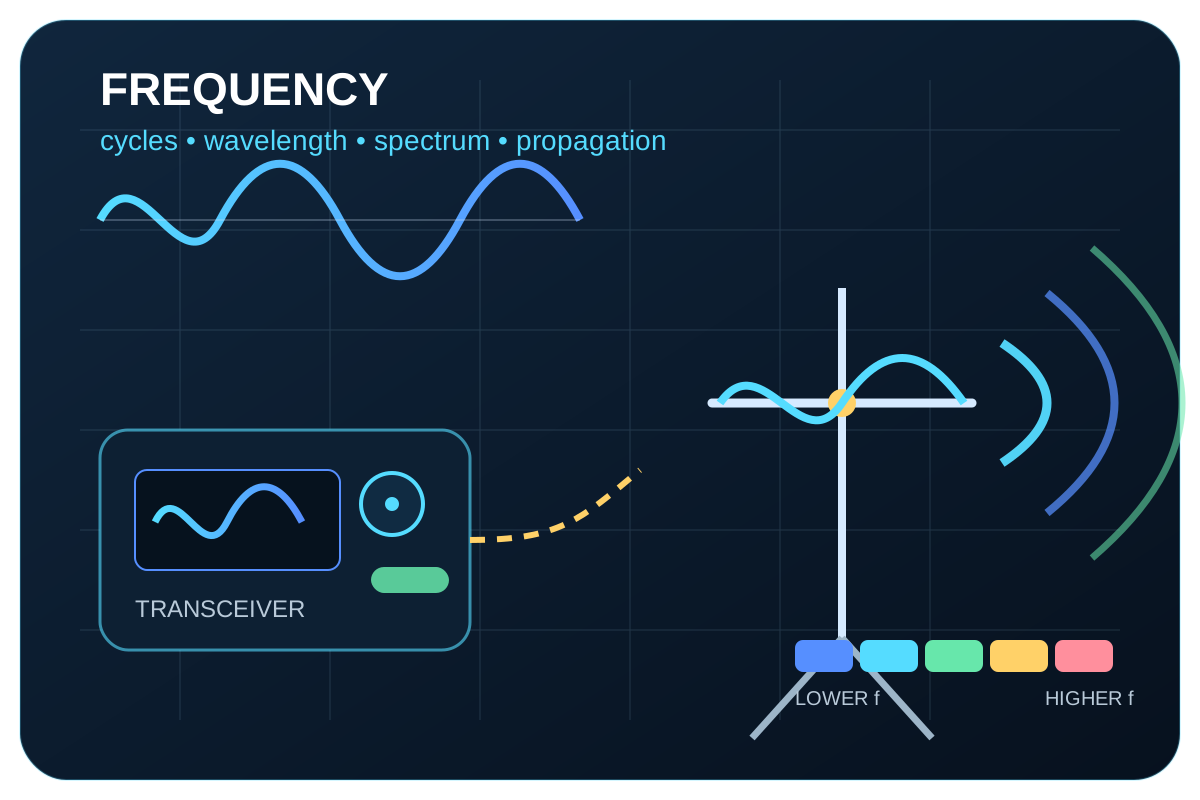
Frequency is one of the most important ideas in radio. It tells us how many complete cycles an alternating signal makes every second. In amateur radio, frequency determines the band being used, influences how the signal propagates, and helps determine the size and design of the aerial system.
2. What is frequency?
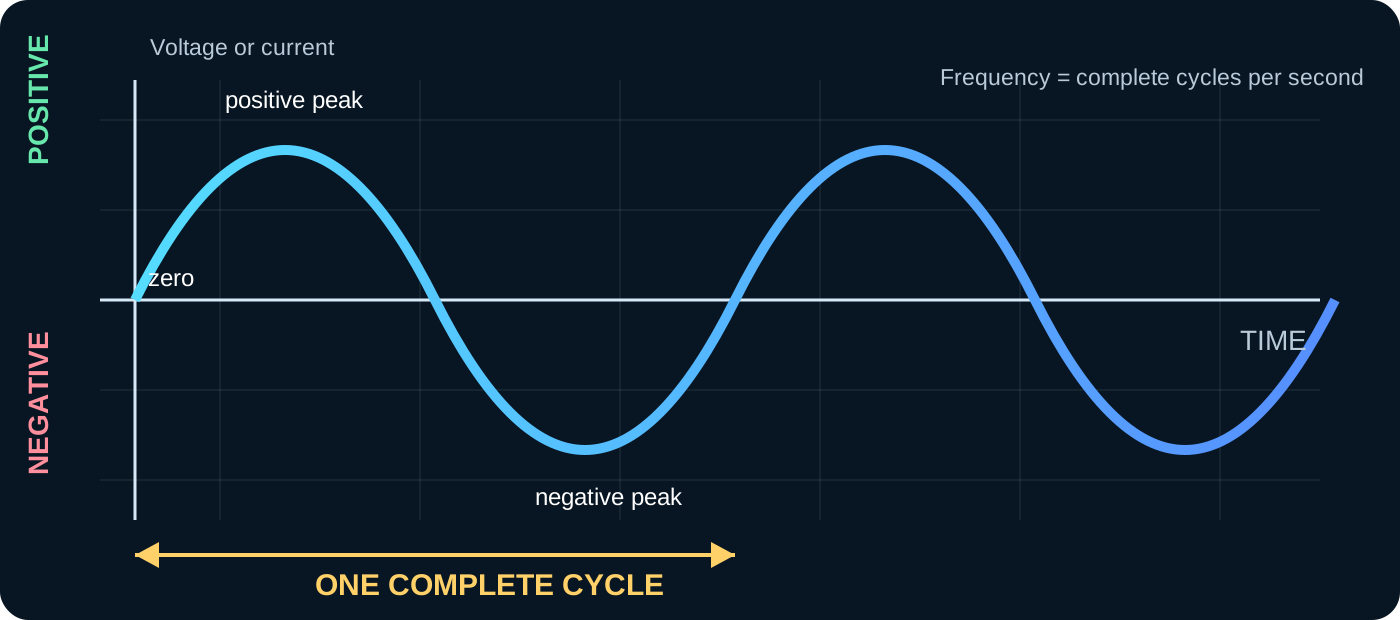
Frequency is the number of complete cycles of an alternating voltage, current or wave that occur every second. It is measured in Hertz, abbreviated to Hz.
In one complete AC cycle, the voltage rises positive, falls through zero, becomes negative, and returns through zero to its starting point. The polarity changes twice during the cycle, but frequency is counted by the number of complete cycles per second.
3. Common frequency units
| Unit | Name | Equivalent | Typical radio example |
|---|---|---|---|
| Hz | Hertz | 1 cycle per second | 50 Hz UK mains electricity |
| kHz | kilohertz | 1,000 Hz | Medium-wave broadcast frequencies |
| MHz | megahertz | 1,000,000 Hz | Most HF, VHF and UHF amateur bands |
| GHz | gigahertz | 1,000 MHz | Microwave, satellite and radar systems |
4. AC power and radio frequency
Electricity in a UK home is normally supplied as 50 Hz alternating current. This is an alternating electromagnetic signal, but its frequency is far below those normally used for radio communication.
A mains cable produces changing electric and magnetic fields, but it is not designed to operate as an efficient transmitting aerial. Radio systems use deliberately generated radio-frequency energy and correctly designed aerials so that useful energy can be launched into space.
5. Frequency and wavelength
Frequency and wavelength are directly linked. As frequency increases, wavelength becomes shorter. As frequency decreases, wavelength becomes longer.
The exact free-space value uses 299.792458, but 300 is the standard radio shortcut.
For example, a signal at 7.1 MHz has a wavelength of approximately 42.25 metres. This is why the amateur band around 7 MHz is commonly called the 40 metre band.
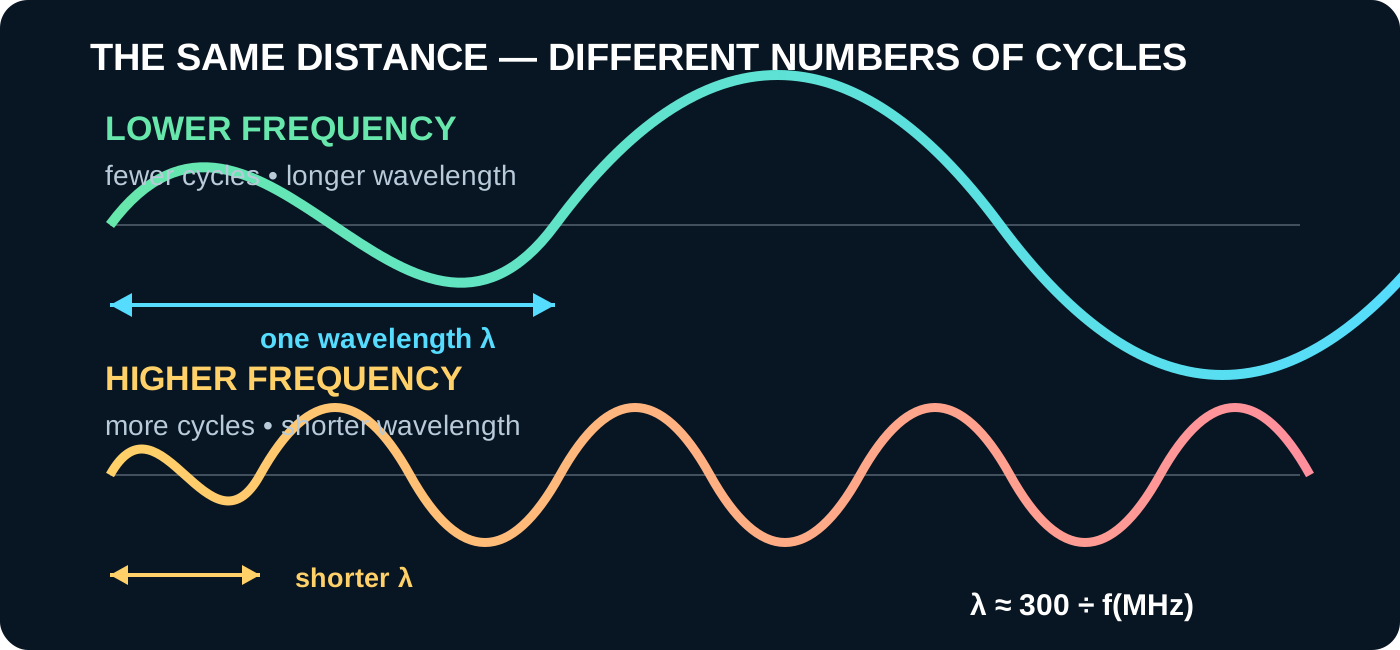
Longer wavelength, generally larger resonant aerials, and propagation that may include ground-wave and ionospheric paths.
Shorter wavelength, generally smaller aerials, and increasingly line-of-sight or specialised propagation.
A half-wave aerial for 3.5 MHz is far longer than a half-wave aerial for 144 MHz.
6. The electromagnetic spectrum
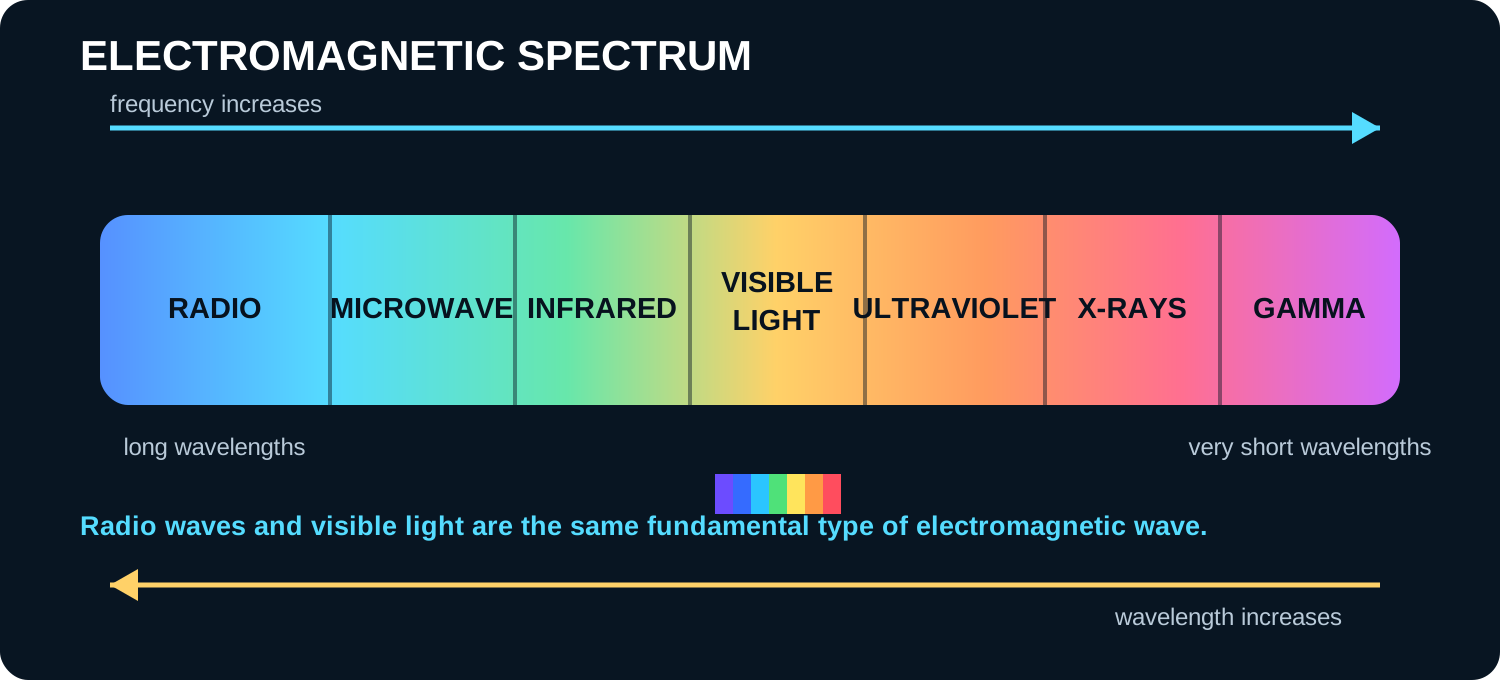
Radio waves are part of the electromagnetic spectrum. They are the same fundamental type of travelling electromagnetic energy as visible light, but they occupy a much lower frequency range.
As frequency increases beyond the radio and microwave regions, the spectrum continues through infrared, visible light, ultraviolet, X-rays and gamma rays.
7. Named radio-frequency bands
The radio spectrum is divided into internationally recognised named bands. These names describe broad frequency ranges; individual services are allocated particular parts of each range by national and international regulators.
| Band name | Frequency range | Typical meaning or use |
|---|---|---|
| LF Low Frequency |
30 kHz to 300 kHz | Long-range low-frequency services, navigation and specialist communication. |
| MF Medium Frequency |
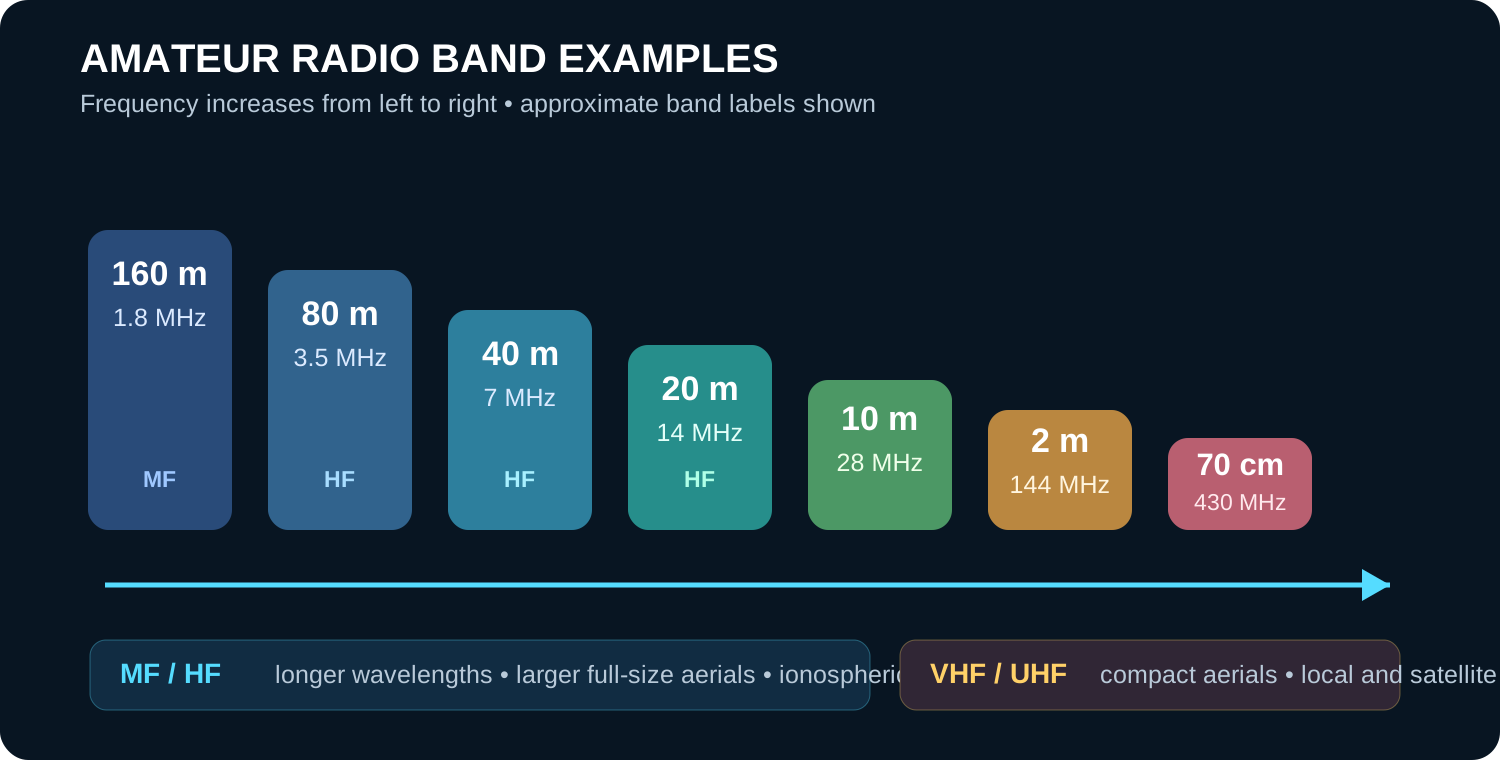
300 kHz to 3 MHz | Medium-wave broadcasting and lower-frequency communication. The amateur 160 m band is technically within MF. |
| HF High Frequency |
3 MHz to 30 MHz | Short-wave radio and many amateur bands, including 80 m, 40 m, 20 m, 15 m and 10 m. |
| VHF Very High Frequency |
30 MHz to 300 MHz | Local and regional communication, including the amateur 6 m, 4 m and 2 m bands. |
| UHF Ultra High Frequency |
300 MHz to 3 GHz | Repeaters, satellites, mobile systems, wireless data and the 70 cm amateur band. |
| SHF Super High Frequency |
3 GHz to 30 GHz | Microwave communication, radar, satellite links and amateur microwave work. |
| EHF Extremely High Frequency |
30 GHz to 300 GHz | Millimetre-wave systems, specialist links and advanced research. |
8. How the main amateur bands fit in
Amateur bands are often described by their approximate wavelength rather than by frequency. The names are convenient labels, so the quoted wavelength is not always the exact wavelength at every frequency in the band.
9. Frequency and propagation
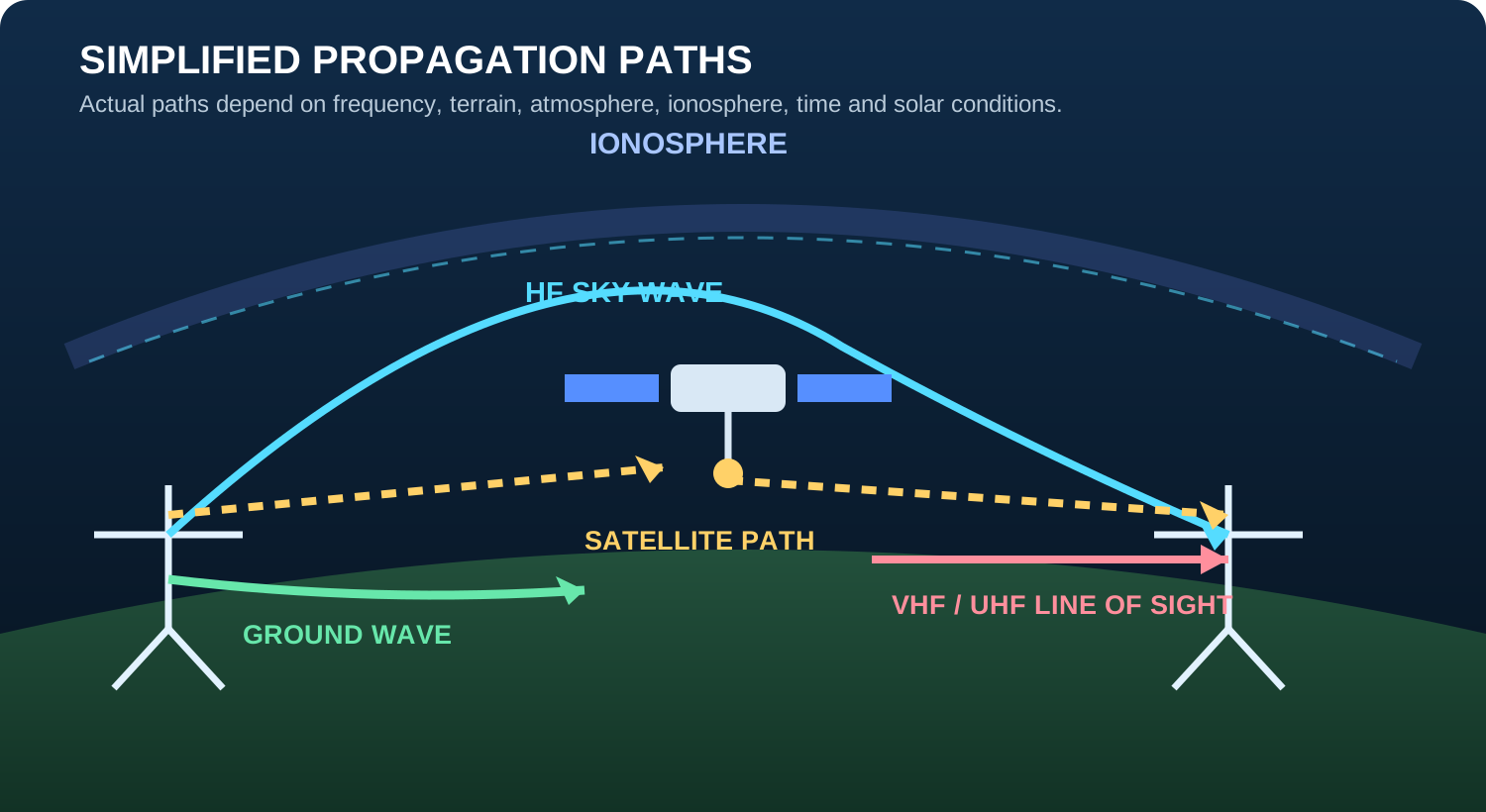
Different frequencies behave differently because they interact with the ground, terrain, buildings, the atmosphere and the ionosphere in different ways.
HF signals can often be refracted by ionised regions of the upper atmosphere and return to Earth hundreds or thousands of miles away. This makes HF especially valuable for DX communication. The usable path changes with frequency, time of day, season, solar activity and local noise.
VHF and UHF signals are more commonly used over line-of-sight and slightly beyond-line-of-sight paths. They are well suited to local communication, repeaters, hilltop portable operation, satellites and propagation modes such as tropospheric enhancement, aurora and meteor scatter.
10. Frequency and aerial size
Aerial dimensions are normally related to wavelength. A half-wave dipole for 40 metres is much longer than a half-wave dipole for 2 metres. This is why full-size HF aerials often require significant space while VHF and UHF aerials can be compact and portable.
Long HF aerials; a practical half-wave dipole is roughly 20 metres overall.
Medium-sized HF aerials; a half-wave dipole is roughly 10 metres overall.
Compact aerials; a half-wave dipole is approximately 1 metre overall.
Very compact aerials; a half-wave element is only a few tens of centimetres long.
11. In simple terms
Frequency tells us how fast a signal is changing. Low frequencies have long wavelengths, while high frequencies have short wavelengths. Radio, microwaves, infrared, visible light, ultraviolet, X-rays and gamma rays all belong to the same electromagnetic family, but occupy very different parts of the spectrum.
For amateur radio, understanding frequency helps us choose the correct band, aerial, feed system and operating method for the contact we want to make.
Further reading: RSGB band plans · Ofcom amateur radio information
Frequency, wavelength and aerial size
Enter a frequency and choose its unit. The calculator shows free-space wavelength plus practical starting lengths for half-wave and quarter-wave aerial elements.
The practical aerial lengths use the common starting formula 143 ÷ MHz for a half-wave dipole. Final length depends on conductor size, insulation, height and surroundings.